Rice Quality & Buyer Specification Guide
What "Grade 1", "5% broken" or "long grain" actually mean when sourcing rice, how milling degree and moisture are set by different standards, and what Tanzania's own growing regions and export practice look like in detail. Grading conventions here are industry/regional-standard-wide, not Tanzania-specific unless stated -- see our Tanzania rice overview for origin, production and market context.

Harvest Seasonality
- Jan -- Secondary harvest
- Feb -- Secondary harvest
- Mar -- Outside main harvest
- Apr -- Outside main harvest
- May -- Outside main harvest
- Jun -- Peak harvest
- Jul -- Peak harvest
- Aug -- Peak harvest
- Sep -- Outside main harvest
- Oct -- Outside main harvest (current month)
- Nov -- Outside main harvest
- Dec -- Outside main harvest
Tanzania splits into bimodal areas (minor Vuli season: planting Oct/Nov, harvest Jan/Feb; main Masika season: planting Feb/Mar, harvest Jul/Aug) and unimodal central/southern areas (single Msimu season: planting ~Nov, main harvest reported at roughly May-Jul, 60-70% of annual production there). We could not confidently map each major rice region (Kilombero/Morogoro, Mbeya, Shinyanga, Tabora) to one calendar with full confidence -- irrigation in valleys like Kilombero further decouples planting from rainfall timing. A secondary signal (local rice prices reported lowest Jul-Oct, highest Feb-Apr) supports a mid-year harvest peak as the dominant national pattern.
Sources: FEWS NET, Preliminary Rural Livelihood Zoning: Tanzania ; REPOA, "Enhancing Competitiveness of Rice Industry in Tanzania" — last verified 8 October 2026
Grading & milling degree -- more than one standard applies
Rice is unusual among the commodities in this series in that a dedicated Codex Alimentarius standard does exist -- CXS 198-1995, Codex Standard for Rice -- rather than the "no global regulator" situation we found for cashew. Tanzania also sits inside the East African Community's own harmonised standard, EAS 128:2011, Milled Rice -- Specification, which the Tanzania Bureau of Standards (TBS) has adopted domestically (also referenced in TBS's own compulsory-standards material as TZS 592:2004(E), Rice -- Specification, alongside companion standards reportedly numbered TZS 1675 for rough/paddy rice and TZS 1676 for brown rice). These are related but not identical documents, and -- as the moisture section below shows -- their numeric ceilings don't always match.
Degree of milling is defined consistently across the sources we checked:
- Paddy / rough rice
- The harvested grain with its husk still on -- not yet processed for consumption.
- Husked rice / brown rice / cargo rice
- Paddy rice from which only the husk has been removed; the bran layers and germ remain.
- Milled rice / white rice
- Husked rice from which all or part of the bran and germ has been removed by milling.
- Under-milled
- Milled, but not to the degree required for "well-milled" -- bran remains visibly on the grain.
- Well-milled
- Some of the germ, all of the external bran layers, and most of the internal bran layers removed.
- Extra-well-milled
- Almost all of the germ, all external bran layers, most internal bran layers, and some endosperm removed -- the most thoroughly polished grade.
- Parboiled rice
- Paddy or husked rice that has been soaked in water and heat-treated so the starch fully gelatinises, then dried -- a distinct process from ordinary milling, done before husking/milling rather than after.
Sources: Codex Standard for Rice, CXS 198-1995 (definitions of milling degree and parboiling); IRRI Rice Knowledge Bank, Milling and processing.
Grain length & shape -- genuinely disputed cut-offs
"Long grain" sounds like a fixed fact. It isn't -- we found at least four different millimetre thresholds across otherwise-credible references, and no single source we found explicitly defers to another:
| Source | Extra long | Long | Medium | Short |
|---|---|---|---|---|
| IRRI Rice Knowledge Bank classification (per secondary summaries of IRRI's own grain-size tables) | >7.50mm | 6.61–7.50mm | 5.51–6.60mm | <5.50mm |
| A commonly cited FAO/Codex-adjacent convention | >7.0mm | 6.0–6.99mm | 5.0–5.99mm | <5.0mm |
| A separately cited "Codex" cut-off (we could not reconcile this with the figure directly above, and did not find it in CXS 198-1995's own text) | — | ≥6.6mm | 6.2–6.6mm | <6.2mm |
| US trade convention (length combined with a length:width shape ratio, not length alone) | — | 6–8mm, ~3–4× width | 5–6mm, ~2–3× width | 4–5mm, plump/near-round |
We are flagging this as an unresolved discrepancy, not picking a winner. Buyers should specify grain length as a measured millimetre range (and, if it matters, a length:width ratio) in the purchase order itself, rather than relying on "long grain" as a self-defining term. Sources: IRRI Rice Knowledge Bank (via secondary grain-size summaries); CXS 198-1995 (which we read directly for milling-degree and moisture definitions above, but whose own grain-classification table we could not locate in those exact terms); general US rice-trade descriptions of long/medium/short grain.
Moisture -- two different ceilings, two different scopes
| Source | Moisture ceiling | Scope |
|---|---|---|
| CXS 198-1995 | 15% m/m maximum | Global Codex default -- the standard itself notes lower limits should be set for destinations where climate, transport duration and storage warrant it. |
| EAS 128:2011 (East African regional standard, per our reading of the primary text) | 13% maximum, all grades | Regional/Tanzania milled-rice specification. |
| A widely repeated US/trade figure | 14% maximum, "as received basis" | Commonly quoted milling/export convention -- 14% is also cited elsewhere as the moisture level that minimises breakage during milling itself. |
These are not necessarily a contradiction -- Codex sets a looser global ceiling while the East African standard narrows it for the regional/Tanzania market -- but a buyer quoting "15% per Codex" and a Tanzanian mill applying EAS 128's 13% ceiling are not citing the same number, and the gap is large enough to matter commercially. Sources: CXS 198-1995; EAS 128:2011, Milled Rice -- Specification (read via the primary text hosted on law.resource.org; we could not cross-check every figure against a second independent copy of the standard).
Broken grain, chalky grain & defect tolerances
Codex defines the underlying terms -- a large broken kernel is a fragment between three-quarters and one-half the length of a whole kernel of the same variety; a chalky kernel (except in glutinous rice) is one where at least three-quarters of the surface is opaque and floury. EAS 128:2011 then sets a three-grade tolerance table we read directly from the standard's own text:
| Factor | Grade 1 | Grade 2 | Grade 3 |
|---|---|---|---|
| Broken kernels (max %) | 5% | 7% | 15% |
| Chalky kernels (max %) | 2% | 4% | 10% |
| Red / red-streaked kernels (max %) | 2% | 6% | 12% |
| Damaged kernels (max %) | 1.5% | 2% | 3% |
| Heat-damaged kernels (max %) | 1–1.5% | 2.0% | |
| Foreign matter (max %) | 0.1% -- same for every grade | ||
| Paddy grains (max %) | 0.3% -- same for every grade | ||
| Live weevils / live insects | Nil -- zero tolerance, every grade | ||
| Aflatoxin | Total aflatoxin max. 10 µg/kg; aflatoxin B1 max. 5 µg/kg | ||
We found a conflicting secondary description of what we believe is the same TBS/regional standard, citing a two-tier "Grade A / Grade B" structure instead (15% broken for Grade A, 25% for Grade B; 14% moisture; 6% chalky grains; 5 µg/kg total aflatoxin) -- numbers and a grading structure that don't match the Grade 1/2/3 table above. We could not resolve which description is current, or whether both exist for different rice types/markets, so we report both rather than silently pick one: treat any single-number claim about Tanzania's rice grading as needing confirmation against the specific standard document and edition a counterpart is actually quoting. Separately, Codex's own physical-characteristics compendium (reproducing what appears to be a Premium/Grade 1/Grade 2/Grade 3 milled-rice table in the US style) cites head-rice minimums of 95%/80%/65%/50% and foreign-matter maximums of —/0.10%/0.20%/0.50% respectively for those grades -- a different grading ladder again, which we have not reconciled with EAS 128's Grade 1/2/3 above. Sources: EAS 128:2011; FAO, "Physical grain characteristics of paddy/milled rice and its grades and standards"; TBS compulsory-standards summaries (secondary, not independently opened by us in primary form for the Grade A/B figures).
Packaging
As with cashew, standard export packaging for rice is industry convention, not a figure fixed by Codex, EAS 128 or TBS -- the standards above address quality factors, not bag weights.
- PP (polypropylene) woven bags are the dominant export format, most commonly seen at 25kg and 50kg net weight, with 100kg bags also used for some bulk/regional trade.
- Jute bags are used in some markets/origins but appear less dominant for rice specifically than for commodities like sesame (below) or coffee.
- Container-loading figures vary by source and are not standardised -- treat any single "X tonnes per 20ft container" figure as approximate.
These are trade-practice observations, not a cited regulatory figure -- we have deliberately not attached a single named source to the bag-weight convention above, consistent with how we handle unregulated packaging practice elsewhere in this series.
Tanzania-specific: growing regions, strategy and practice
The Government of Tanzania's National Rice Development Strategy (NRDS) dates to around 2009 and set out to roughly double national rice production; a successor, NRDS II, was launched in 2019 with a reported 12-year horizon. We have not independently read either strategy document's full target figures -- we cite their existence and stated aims as reported by secondary policy-brief sources, not as independently verified statistics.
Which regions actually lead production is genuinely disputed between sources, and we are reporting the disagreement rather than merging it into one ranking:
- A REPOA policy brief describes a "big six" of Mbeya, Morogoro, Mwanza, Tabora, Shinyanga and Rukwa, together producing 62% of national output and farming 61% of national rice area in the 2018/2019 season, with Mbeya and Morogoro specifically cited as having above-average productivity.
- A separately sourced 2022 regional breakdown instead ranks Morogoro (15%), Mbeya (10%), Pwani (8%), Mwanza (7%), Geita (6%), Katavi (6%), Simiyu (5%), Ruvuma (5%), Shinyanga (4%) and Kigoma (4%) -- overlapping heavily with the list above but not matching its order or shares.
- Yet another source frames it as Shinyanga, Tabora, Mwanza, Mbeya, Rukwa and Morogoro jointly accounting for over 70% of production.
What is consistent across every source we found: the Kilombero Valley (within Morogoro Region) is Tanzania's single most intensively rice-cropped landscape -- one academic source describes over 80% of its arable floodplain area as monocropped to rice, contributing roughly 9% of national production from that basin alone -- and irrigated cultivation there dates back over a century. Igunga district (Tabora Region) is a documented site of mechanised paddy harvesting. Ndanda (Mtwara Region) and Shinyanga also appear repeatedly across sources as rice-growing areas, though with less production-share data specific to them than the "big six" regions above.
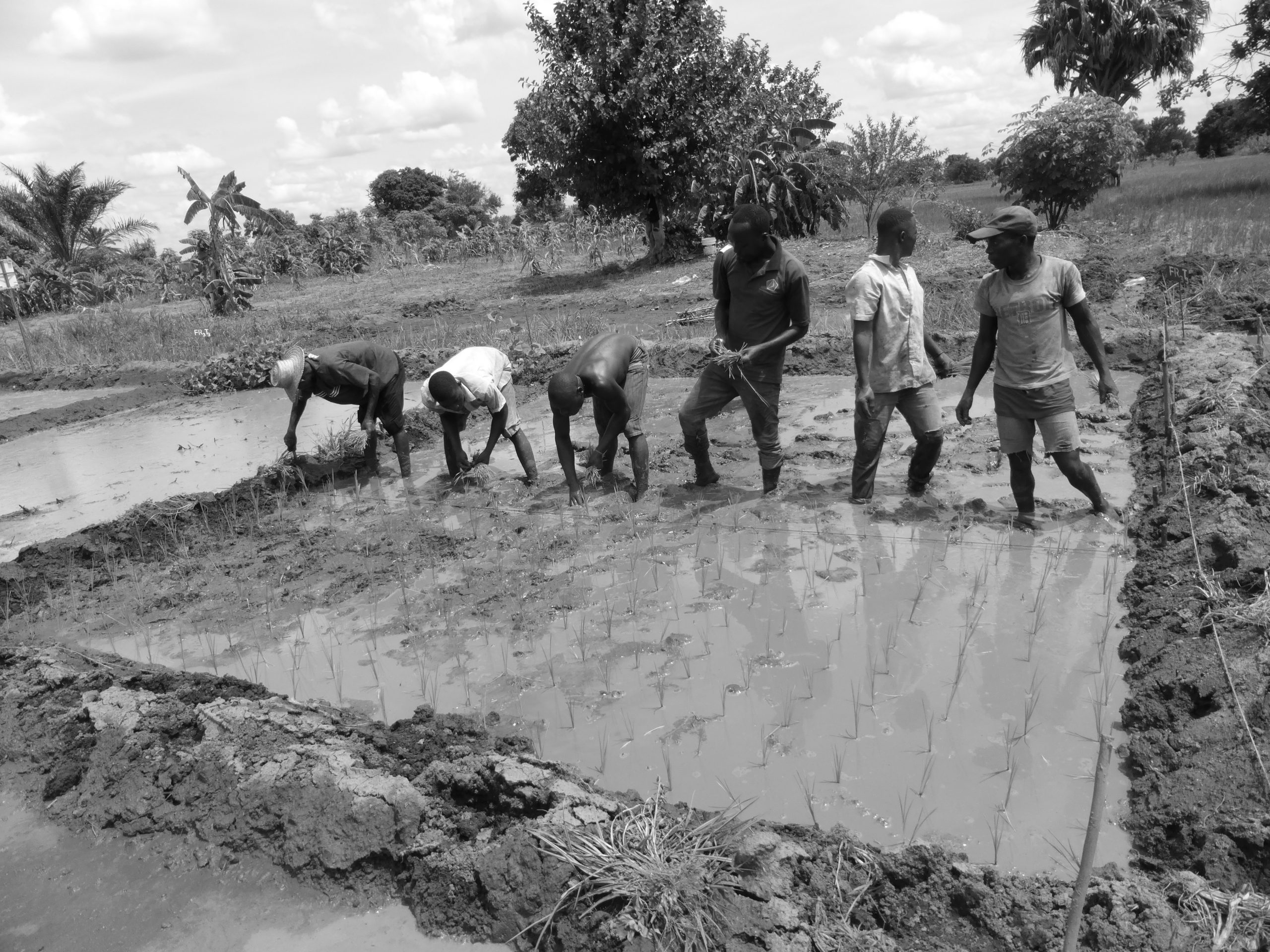

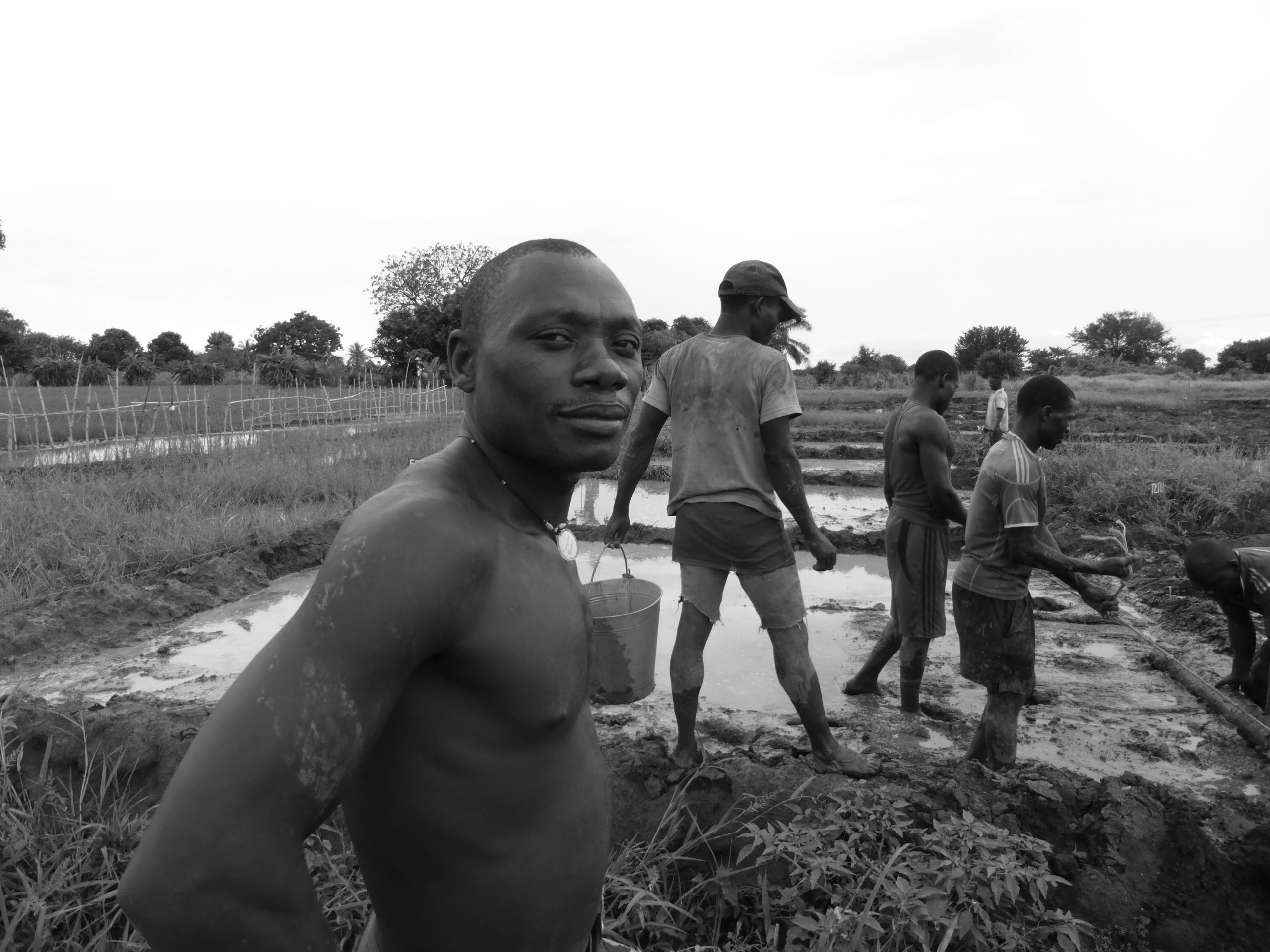
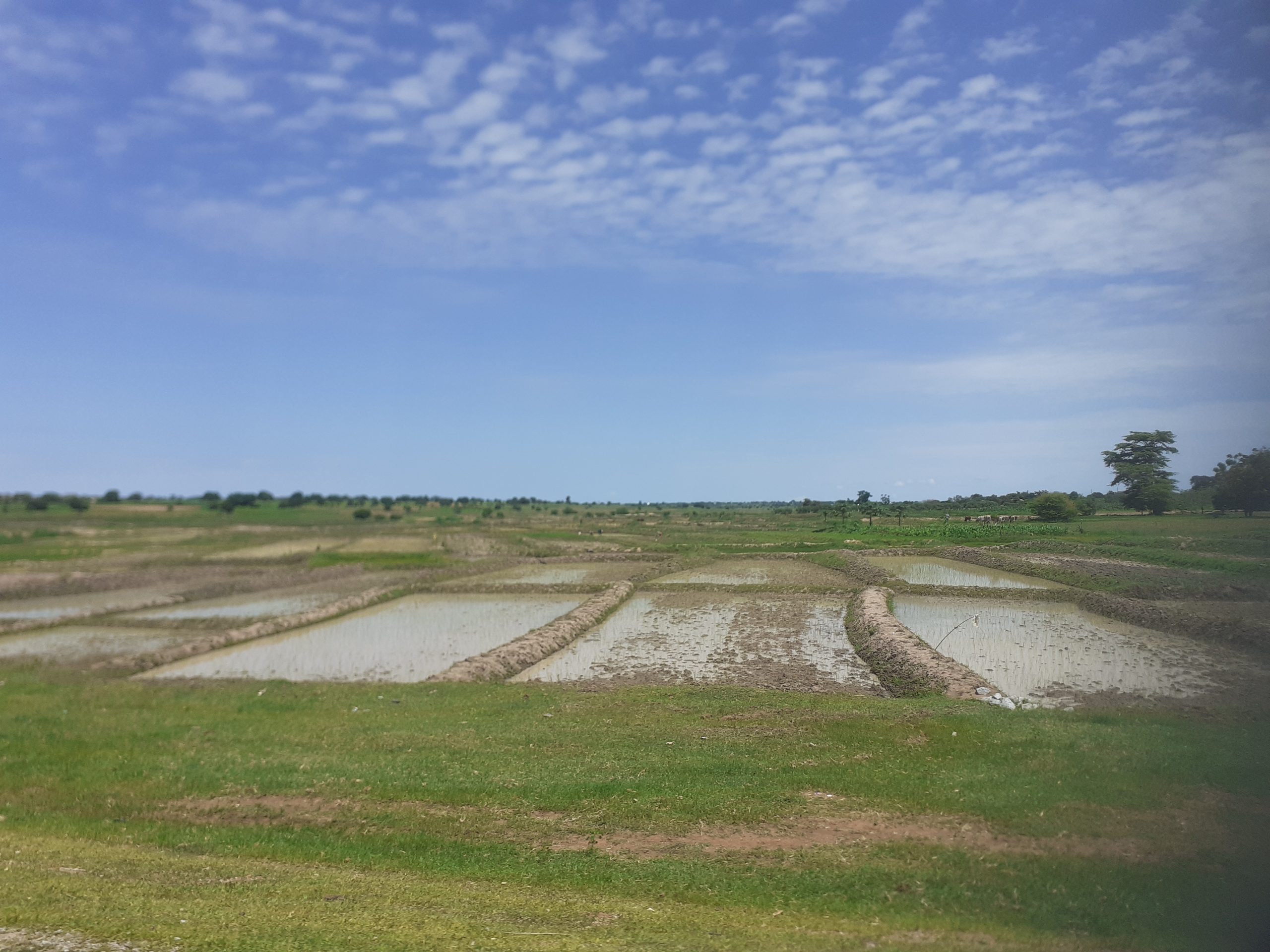
Irrigated vs. rainfed practice: the Kilombero Valley and other irrigated schemes allow land preparation (puddling and levelling, pictured below) and transplanting into standing water -- a different system from rainfed upland paddy, which depends directly on rainy-season timing. This distinction matters for harvest timing (next paragraph): irrigated schemes can shift or extend their planting window relative to rainfed plots in the same region.

Harvest timing is also genuinely regional and not fully resolved by what we found. Tanzania's rainfall splits broadly into bimodal areas (a minor Vuli season, planting roughly October/November and harvesting January/February, followed by the main Masika season, planting February/March and harvesting July/August) and unimodal areas with a single Msimu season (planting around November, the main harvest reportedly landing roughly May–July in central/southern zones and accounting for 60–70% of annual production there). We could not confidently map each specific named region above (Kilombero, Mbeya, Shinyanga, Tabora) to one of these calendars with full confidence -- irrigation further complicates this, since it can decouple planting from rainfall timing in valleys like Kilombero. A consistent secondary signal is that local rice prices are reported as lowest between July and October, immediately after the main harvest, and highest February–April -- consistent with a mid-year (roughly June–August) harvest peak being the dominant national pattern, which is what we have encoded in the harvest calendar above, while flagging that region-by-region precision beyond that is a real gap in what we verified.
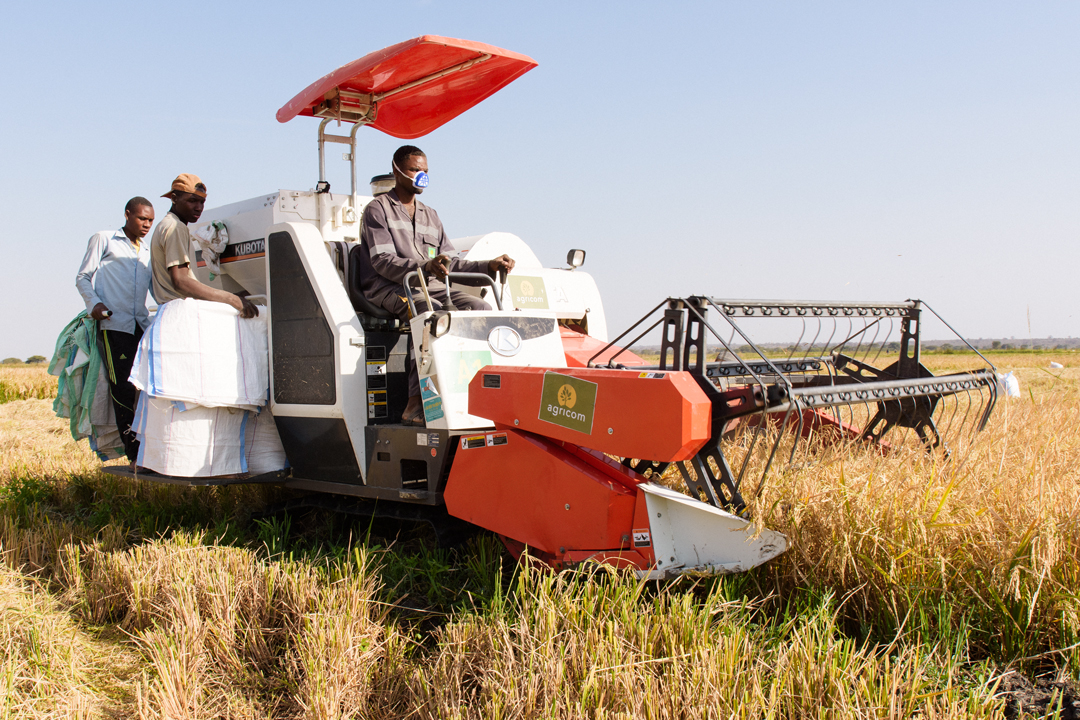

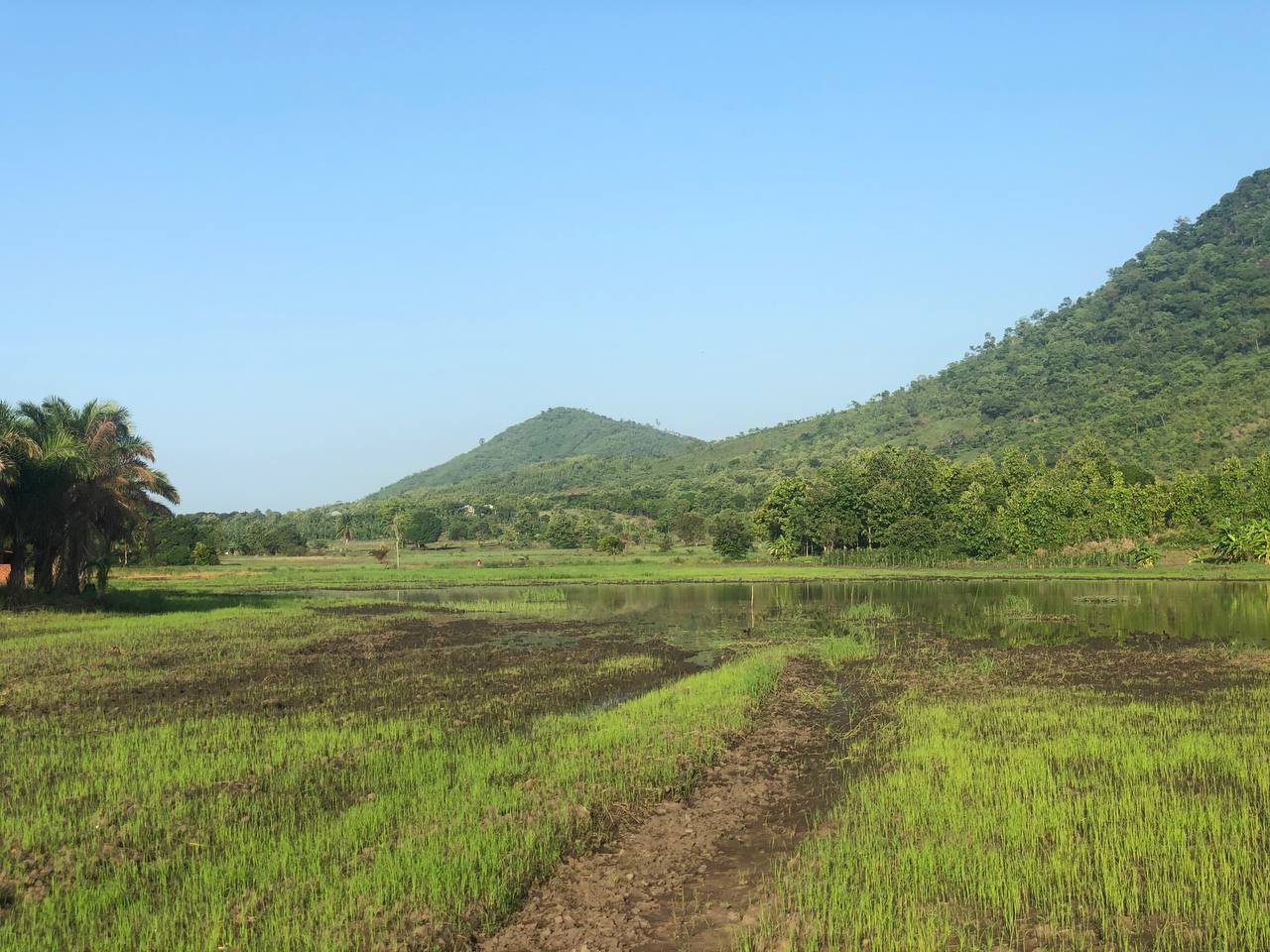
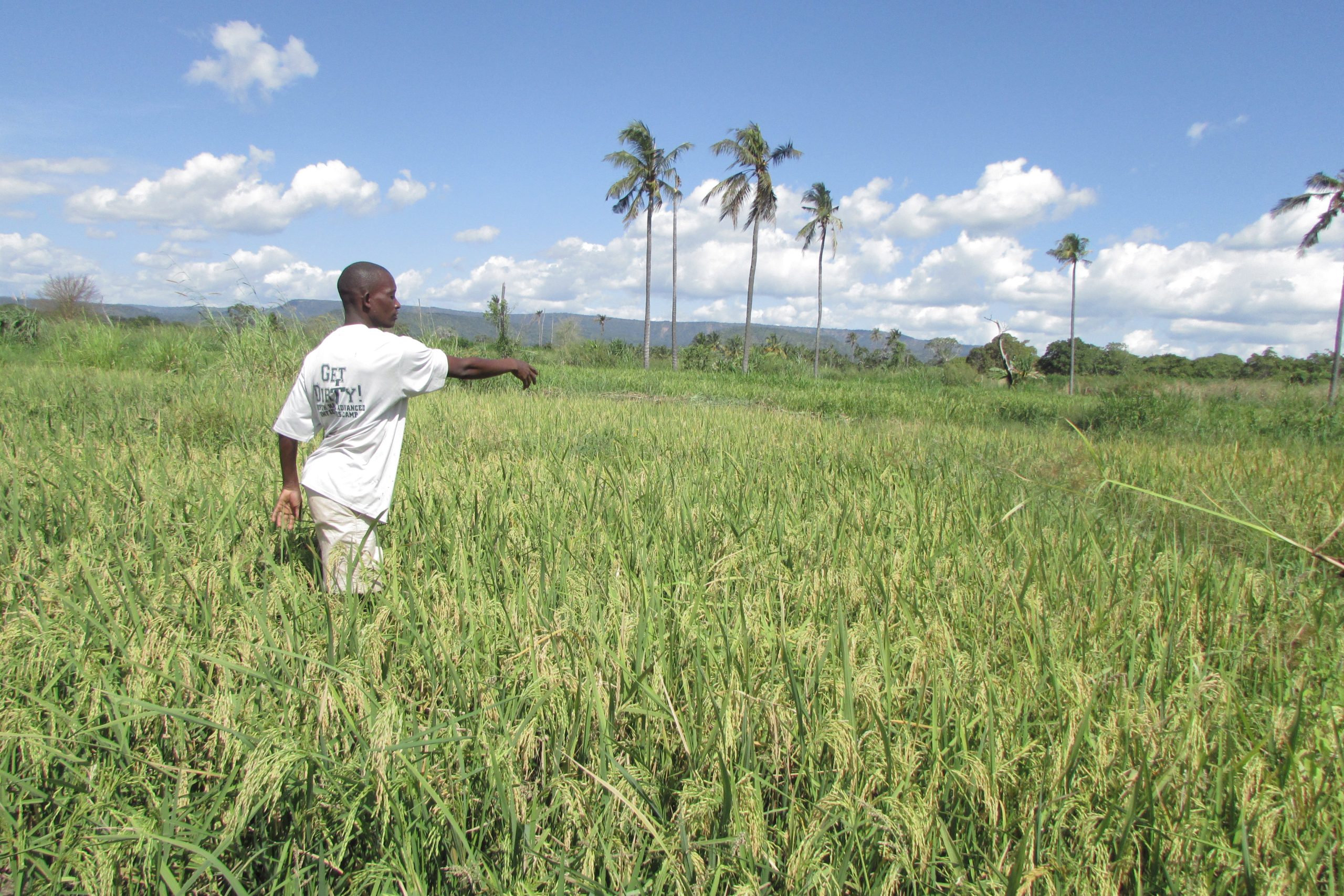
Beyond the Kilombero Valley, rice landscapes and smallholder practice look different region to region:


Sources: REPOA, "Enhancing Competitiveness of Rice Industry in Tanzania" (policy brief); NRDS2 Monitoring & Evaluation Baseline Study, Tanzania (cited for NRDS II's existence and timeline; we could not extract its full text); FEWS NET, Preliminary Rural Livelihood Zoning: Tanzania (bimodal/unimodal seasonal calendars); academic sources on Kilombero Valley rice cultivation (via ResearchGate/Springer indexing, cited for the >80%-monocropped and ~9%-of-national-production figures).
Export documentation
An important caveat on what we actually verified here: the TBS conformity-assessment regime we found clearly documented -- Pre-shipment Verification of Conformity (PVoC), ending in a Certificate of Conformity (CoC) -- governs rice imported into Tanzania (relevant because Tanzania both exports and, in deficit years, imports rice), not Tanzania-origin rice being exported. We did not find a single consolidated government manual for Tanzania-origin rice export documentation comparable to the Cashewnut Board's own rules for cashew, and -- unlike cashew -- we did not find evidence of a dedicated rice marketing board or statutory export levy. The documentation set below is assembled by analogy to common agricultural-export practice (as in our cashew and vanilla guides), not from one verified rice-specific source:
- Commercial Invoice and Packing List
- Bill of Lading
- Certificate of Origin
- Phytosanitary Certificate (Tanzania Plant Health and Pesticides Authority, TPHPA)
- Quality/analysis certificate against the grade and standard quoted (see comparison above)
- TBS inspection/certification where applicable to the destination market
Rice falls under HS Chapter 10, heading 1006, conventionally split into paddy/rough rice, husked/brown rice, milled/semi-milled rice, and broken rice sub-headings -- the specific sub-heading claimed on export documents should match the product's actual milling degree as defined above, not just its trade name.
See also our wider Quality Inspection & Pre-Shipment Verification and Incoterms for Commodity Buyers guides for the cross-commodity detail behind both.
Buyer specification checklist
Worth putting in an RFQ or purchase order, whether or not every field applies to your order:
- Standard & grade quoted -- e.g. "Grade 1 per EAS 128:2011" -- don't assume a bare "Grade 1" implies one specific moisture/defect table, given the disagreements documented above.
- Milling degree -- paddy, brown/husked, well-milled, extra-well-milled, or parboiled.
- Grain length & shape -- specify a measured mm range and, if relevant, length:width ratio, rather than relying on "long/medium/short grain" alone.
- Moisture -- a target maximum, and which standard's ceiling it's measured against (13%, 14% or 15% all appear in sources above).
- Broken-grain percentage -- and whether "broken" is defined the same way your supplier uses it.
- Defect tolerances -- chalky, red/red-streaked, damaged, heat-damaged, foreign matter, paddy content -- see the comparison table above for which table applies.
- Packaging -- PP woven bag vs. jute, and net weight (25kg/50kg/100kg).
- Certification requirements -- organic, fair-trade or other, if applicable, and who issued it.
- Testing requirements -- certificate of analysis, third-party lab, or your own incoming inspection.
- Destination & Incoterm -- see our Incoterms for Commodity Buyers guide.
Sample & inspection guidance
- Appearance -- grain uniformity in length/shape, translucency (chalky grains show as opaque/floury patches), colour (red streaking is a defined defect category above).
- Milling degree -- visible bran residue indicates under-milling; compare against the degree specified.
- Broken grain and foreign matter -- a visual estimate is a screening step only; the percentage tables above require sieve/weight-based lab measurement to confirm, not inspection by eye.
- Pest activity -- zero tolerance for live weevils/insects under the standard we read; inspect for live insects or webbing.
- Odour -- should smell clean, not musty, sour or fermented -- off odours can indicate poor drying or storage.
- Packaging condition -- intact bags, no moisture ingress, correct net weight.
A visual/aroma sample check is a screening step, not a substitute for laboratory testing -- moisture percentage and precise defect-percentage grading require lab/sieve equipment to confirm. Our general Quality Inspection & Pre-Shipment Verification guide covers the wider pre-shipment inspection process that applies across commodities, including rice.

Full Tanzania rice profile
Origins, production regions, processing in practice, and market/trade data with sources.
Read the full profile →Suppliers
Flamingoo Foods Company Limited
Rice aggregator and processor sourcing aromatic rice (Supa Kyela, Nakonde and Maramata varieties) from smallholder farmers…
Raphael Group
Rice milling, farming, trading, warehousing and transport company based near Mbeya on the Tanzania-Malawi/Zambia highway corridor.…
LICO Global Company Limited
Dar es Salaam-based agricultural commodity exporter and importer dealing in grains (white rice, sorghum, maize, sesame),…
Kapunga Rice Plantation Limited
Large-scale rice estate and processor (part of Export Trading Group), approximately 4,700 hectares with 10,000+ contracted…
KOM Food Products Company Limited
Rice milling and agro-processing company in Kahama district, Shinyanga, part of the Kahama Oil Mill (KOM)…
Wilmar Tanzania Limited
Rice and edible oils/agribusiness miller and trader, Dar es Salaam-based subsidiary of Wilmar International (Singapore).
Last reviewed 8 October 2026. Sources cited inline above; see also Data Sources and Methodology for how we handle disagreeing figures and unverifiable claims.